
Speech Delay · Communication
When “How Was Your Day?” Is Too Big a Question
By Phizzics Davis · 8 min read
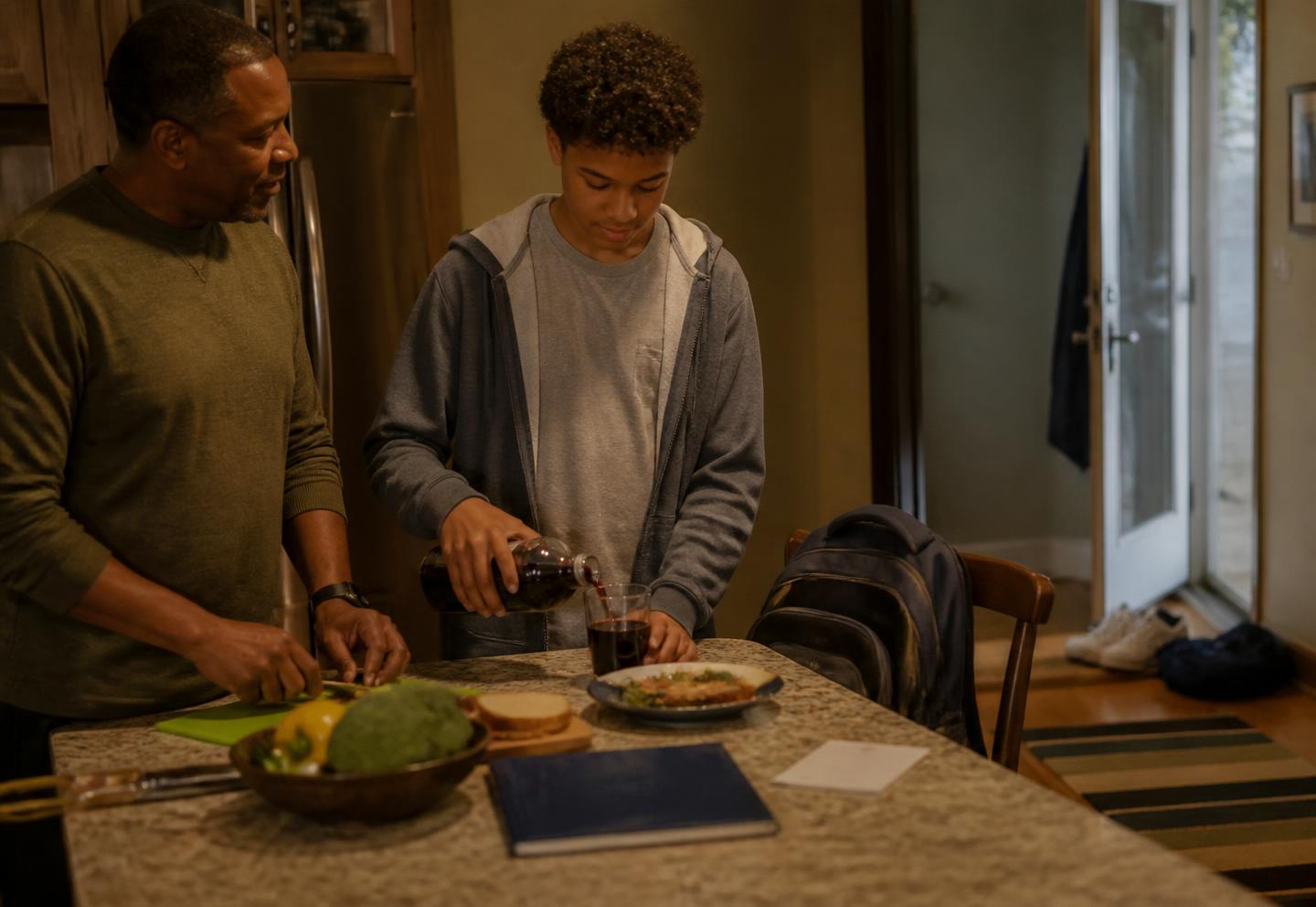
“How was your day?”
It’s one of the most ordinary questions a parent can ask.
We ask it at school pickup.
In the car.
While making a snack.
At the dinner table.
It sounds simple.
I used to think it was simple too.
But for my son, sometimes that question was simply too big.
Not because nothing happened during his day.
Not because he didn’t have anything to share.
And not necessarily because he didn’t understand what I was asking.
Sometimes he just didn’t know where to begin.
I had to learn how to make the question smaller.
Five words can contain an enormous question
Think about what we’re actually asking when we say:
“How was your day?”
We’re asking someone to mentally travel backward through several hours.
School arrival.
Classes.
Lunch.
Activities.
Conversations.
Things that went well.
Things that didn’t.
Then we’re asking them to decide which of those experiences we’re interested in.
Retrieve the memory.
Organize it.
Find the language.
And give us an answer.
For someone who needs more processing time or support organizing language, that’s not one small question.
That’s a series of tasks hidden inside five words.
And if you don’t know which part you’re supposed to answer first, sometimes the easiest answer is:
“Good.”
Or:
“I don’t know.”
Or nothing.
I began to realize that instead of repeatedly asking the big question, I could give my son a smaller place to begin.
Sometimes two choices are enough to get us started
Offering choices became one of the ways I helped my son enter a conversation.
Instead of:
“What did you do today?”
I could ask:
“Did you have gym or art?”
And wait.
Instead of:
“What did you eat?”
I might offer:
“Pizza or chicken?”
And wait.
Instead of:
“Did you have fun?”
I could make the idea more concrete:
“Was gym fun or hard?”
Two choices aren’t meant to become the entire conversation.
They’re a starting point.
They reduce the number of possibilities someone has to sort through before answering.
And sometimes, once my son had that starting point, he could find the word he needed.
Other times he still needed help.
That was okay too.
Processing time is part of the conversation
This is something I’ve had to practice myself.
Ask.
Then wait.
When you know someone is having trouble finding an answer, the instinct is to help immediately.
You ask again.
You change the question.
You offer another choice.
You start explaining what you meant.
And suddenly the person who was processing the first question now has four more pieces of language to process.
I’ve learned to give my son the choices and then give him time to think.
The pause isn’t necessarily the end of the conversation.
Sometimes it’s the middle of his answer.
I learned to do a little homework before asking about his day
This became one of the most useful things for me.
Since he was very young, I would ask his teachers questions.
What did he do today?
What did he eat?
Did he participate in anything different?
Was there a special activity?
As he got older, having teachers who communicated what happened during the school day made an enormous difference.
Daily folders with a quick synopsis of the day’s activities gave me something incredibly valuable:
context.
Now I wasn’t asking him to retrieve an entire day while I knew absolutely nothing about it.
I had somewhere to start.
If the folder said they had participated in a dance activity, I could ask about the dance activity.
If I knew what was served at lunch, I could ask whether he tried it.
If I knew they played a game in gym, I could ask about the game.
Suddenly:
“How was your day?”
could become:
“I heard you played a game in gym today. Did you play or watch?”
That’s a very different question.
Knowing part of the answer isn’t cheating
This is something I think parents need permission to hear.
Sometimes I already knew the answer to the question I was asking.
That was intentional.
I wasn’t testing him.
I was trying to create an opportunity for conversation.
If I knew he had tried a new food, I could give him the starting point.
“Your teacher told me you tried something new today. Was it the chicken or the rice?”
Maybe he could answer.
Maybe he needed more prompting.
Maybe I supplied most of the language that day.
But the interaction still mattered.
Because my goal wasn’t to determine whether he could pass a quiz about what happened at school.
My goal was to help him experience the rhythm of:
I say something.
You respond.
I respond to you.
We keep going.
That’s conversation.
And sometimes I carried the conversation a little farther for him
There were times when I asked a question, offered choices and waited—and still didn’t get much of an answer.
I didn’t always let that mean the conversation was over.
If I knew he had participated in something new, I could continue:
“You tried the new food today. I’m really proud of you for tasting it.”
Or:
“I heard you joined the game in gym for a little while. That’s great.”
Or:
“You did the dance activity today! I’m proud of you for trying it.”
Maybe he gave me another word.
Maybe an expression.
Maybe a small response.
Maybe nothing else came that time.
But I still wanted him to experience what it felt like for another person to be interested in his day.
And I wanted his attempts to communicate to lead somewhere.
Not every conversation has to be 50/50 to be meaningful.
Sometimes one person carries a little more of it while the other person is learning how to join.
The difference between prompting and testing
This changed the way I thought about questions.
If I ask:
“What did you eat for lunch?”
and I already know the answer, I can use that information in two very different ways.
I can make it a test:
“What did you eat?”
No answer.
“Come on. You know what you ate.”
“Tell me.”
Now we’re trying to prove that he knows.
Or I can use what I know as a bridge:
“I heard you had pizza and fruit today. Which one did you eat?”
Then wait.
Same information.
Completely different pressure.
One asks:
Can you produce the answer I want?
The other says:
Here’s somewhere to start. Let’s see where we can go together.
Give the conversation handles
I think of smaller prompts as giving a big question handles.
Instead of
“What happened at school?”
Try
“Lunch or class?”
Instead of
“What did you do today?”
Try
“Gym or music?”
Instead of
“How did you feel?”
Try
“Good, okay or hard?”
Instead of
“Who did you talk to?”
Try
“Teacher or friend?”
And if the person needs more support, give it.
A choice.
A visual.
A sentence starter.
Something you already know about the day.
The goal isn’t to make the question easier forever.
The goal is to create enough success and familiarity that, over time, the person has more ways to enter the conversation.
Teachers can help families have better conversations at home
One of the simplest supports a teacher can give a family isn’t complicated.
Tell us a little about what happened.
Not a detailed report every afternoon.
Just enough context.
- We tried a new food today.
- We had a guest speaker.
- We played kickball in gym.
- We started a science experiment.
- He participated in the dance activity.
That one sentence can give a parent something concrete to talk about later.
For a child who has difficulty independently recounting their day, that communication between school and home can become a conversation bridge.
Instead of:
“Tell me what happened.”
we can say:
“I heard something happened. Tell me a little more.”
That’s a much smaller distance to travel.
Don’t rush past the attempt
This might be the part that matters most to me.
When my son tried something new, participated in something, answered a question or gave me even a small piece of the conversation, I wanted him to know I noticed.
“I’m proud of you.”
Not only when the sentence was perfect.
Not only when he answered independently.
Not only when we had a long back-and-forth conversation.
The attempt mattered.
Participation mattered.
Trying the new food mattered.
Joining the activity for a little while mattered.
Finding one word mattered.
Because if we’re trying to build confidence around communication, the experience of communicating needs room for success.
A conversation can be supported and still be real
This is something I understand much differently now.
If I give my son two choices, the answer is still his.
If I give him processing time, the answer is still his.
If his teacher gives me context so I can ask a better question, the conversation is still ours.
If I provide the first few words and he completes the thought, he’s still communicating.
Support doesn’t make the interaction artificial.
Sometimes support is precisely what makes the interaction accessible.
And over time, the amount of support can change.
A conversation that once required two choices may eventually need only one prompt.
A response that once needed a sentence starter may eventually come independently.
A child who once answered one question may begin asking one back.
That’s why I stopped thinking only about:
“Can he answer this question?”
and started thinking:
“How can I help him get into this conversation?”
Those are very different goals.
Make the doorway smaller
If “How was your day?” works in your family, wonderful.
But if it doesn’t, that doesn’t mean there isn’t a conversation waiting to happen.
The doorway may simply be too big.
Make it smaller.
Give two choices.
Share what you already know.
Ask about one moment instead of eight hours.
Go first.
Wait longer than feels natural.
Celebrate the attempt.
And if you have to carry a little more of the conversation today, carry it.
You’re still showing what connection sounds like.
You’re still practicing the back-and-forth.
You’re still communicating:
Your day matters to me.
And sometimes that’s where the conversation begins.